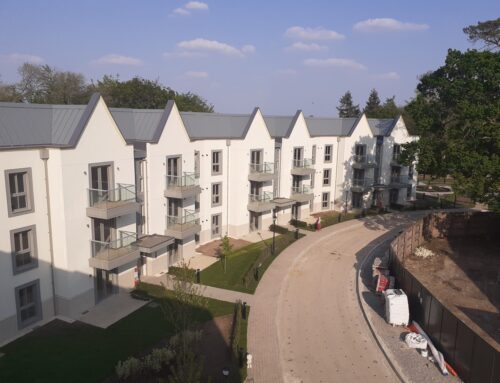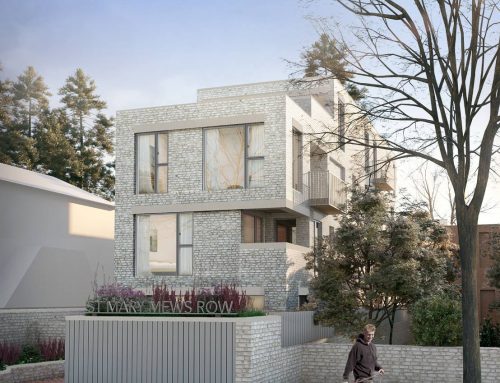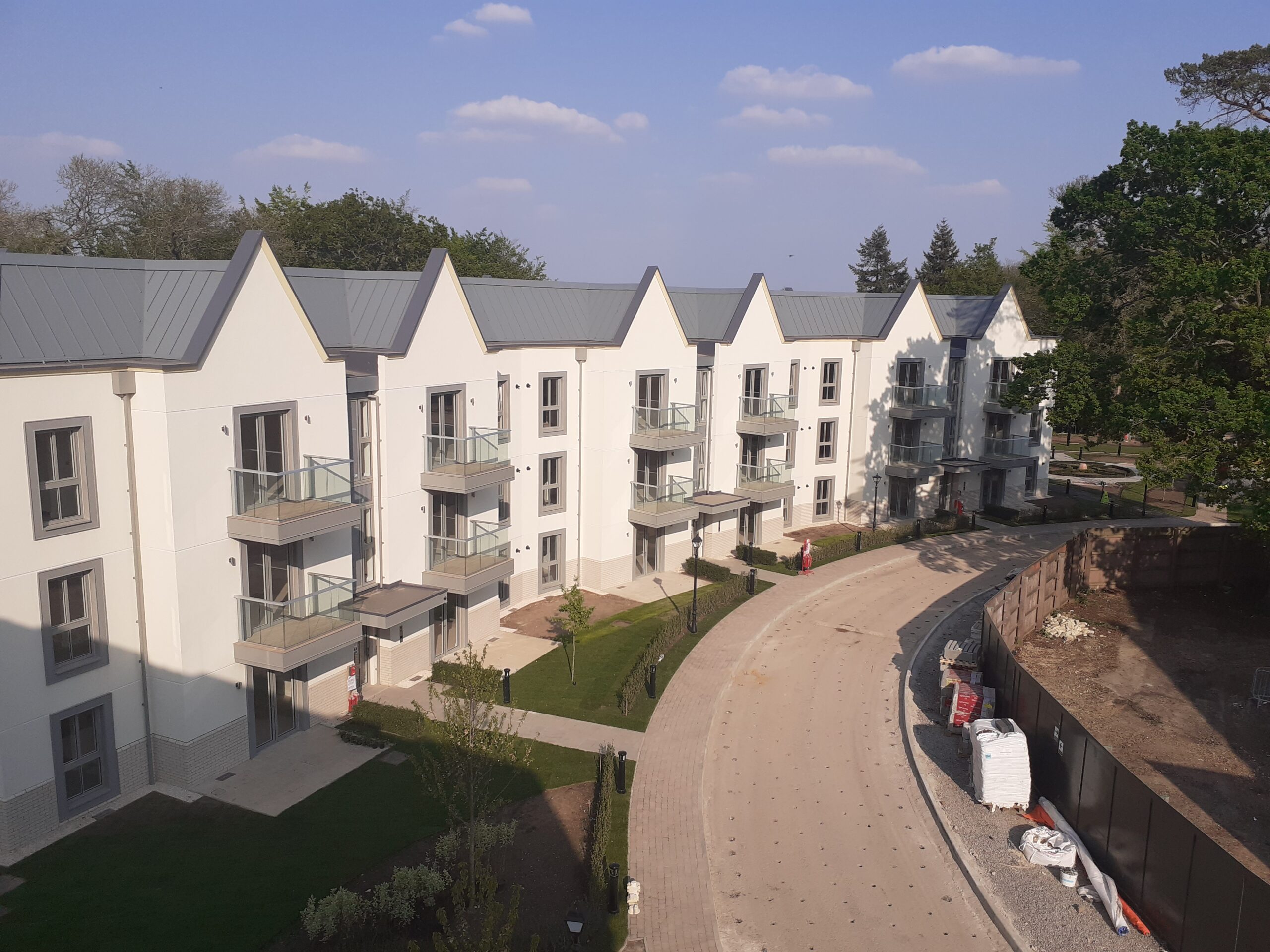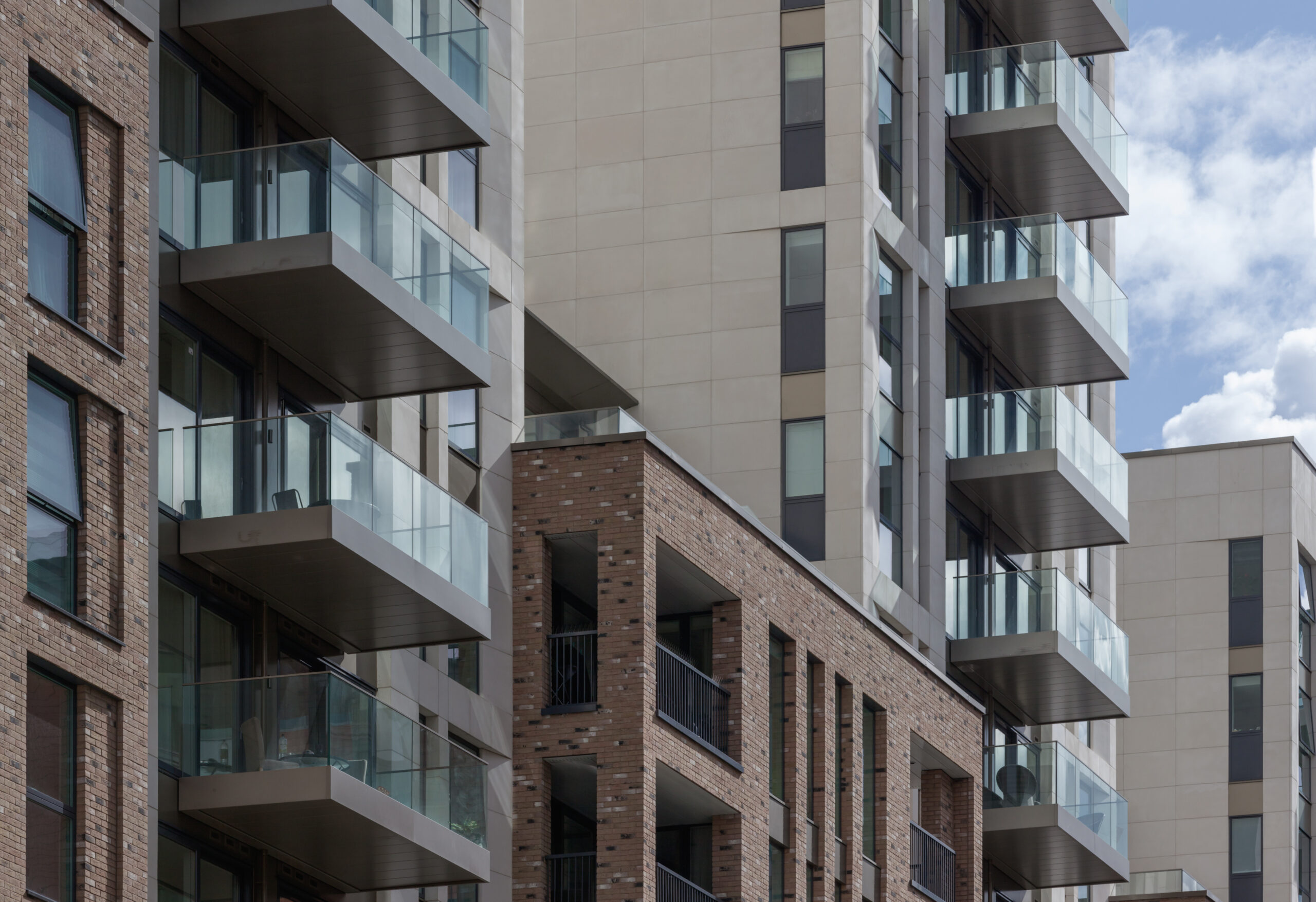
North Wharf Gardens for Venturi UK
UK Building Regulations continue to recommend two forms of ‘safety glass’, namely, Toughened Glass BS EN 12150 and Laminated glass BS EN 14449, as tested in accordance with BS EN 12600 (formerly BS 6206).
Toughened glass is normal annealed, float glass that has been ‘tempered’ by heating and cooling it, which makes it much stronger and therefore significantly better at resisting high impact and thermal stress, caused by conflicting temperatures occurring across the same piece of glass.
In addition, Toughened glass has the added and unique characteristic that if it does smash, it breaks into thousands of tiny fragments, which are not sharp, so there is no danger from falling shards of piercing glass. (Most common example is the side windows in cars, which when broken, shower tiny particles everywhere, but which rarely cut you).
Laminated glass consists of two panes of annealed glass, bonded together by a PVB (Polyvinyl Butyral) plastic sheet interlayer, which has remarkably high resistance against being penetrated by high impact. Therefore, when it suffers impact the glass will break but will remain in place, even after repeated impacts, thereby continuing to prevent access through it. (Most common examples are Jewellers’ windows and windscreens in all cars). Thus, laminated glass is also excellent for security.
However, each of these glass types has an Achilles heel, which must be understood and taken into consideration for use in windows on buildings.
Application of Glass in Residential Buildings
Residential dwellings, whether houses or apartments, need to be both safe and secure, therefore many are built to the standards of SBD (Secured by Design, a Police initiative to design-out crime).
This would typically require a double-glazed unit to consist of one pane of laminated glass on the inside and the other pane of Toughened glass outside. This provides ultimate security from the Laminated and excellent resistance to thermal stress from the Toughened on the outside.
For many years this was the standard for ‘Best Practice’ and recommended universally.
The Achilles Heel Factor:
As referred to above, in recent years there has been growing concern about the risk of spontaneous breakage of Toughened glass, due to Nickel Sulphide (NiS) inclusions in the glass. During the manufacture of glass tiny contaminants of nickel in the molten glass can potentially mix with sulphur from the furnace to form NiS inclusions that can remain in the glass. After the glass has been Toughened at 300C then cooled, the NiS inclusions lie dormant in the glass, until they spontaneously break, causing the whole glass sheet to immediately craze over. Typically, the glass does not actually fall out from a standard 4 sided window for some days, providing the opportunity for recovery before it does.
The frequency of this occurrence is critically significant when assessing the risk because this has been studied at length by industry experts who accept that the incidence is not just ‘rare’ but is ‘extremely rare’ occurring in 1m2 out of 10,000m2 of glass (estimated by GGF), which to put it into perspective would equate to 1 piece of glass in an entire 25 storey, high-rise development of apartments.
Glass Risk Assessment:
In order to assess the level of potential danger, a formal Risk Assessment should be conducted, since there is a considerable difference in risk to health, from a domestic window breaking on the ground floor of a house, to a glazed atrium high above a shopping arcade.
To reduce the worst-case risk, over the arcade, a process called Heat Soak Testing, can be employed, in which the Toughened glass is re-heated to circa 300C and held for 4 hours before cooling. This will often cause any latent NiS inclusions to break during the test. The resultant HST Toughened glass (BS EN 14179) is still not immune from NiS breakage, but the occurrence will have been reduced to circa 1m2 out of 1 million m2.
In all other applications, the glass risk assessment will help identify degrees of danger from the location – balanced against degrees of severity to injury. Thus, a low risk for a window above a landscaped area, to a higher risk if above an external pedestrian area. Therefore, a specification might be agreed to fit Toughened glass over the landscaping and only HST Toughened above the pedestrian area.
The cost of the HST treatment is circa £2 per mm, per square mm. Thus, for 6mm Toughened glass this would be about £12/m2, extra.
The Alternatives:
Locating the Toughened glass on the inner face will eliminate the risk of glass falling from height, even if there was a NiS breakage.
Some specifiers, clients and consultants, today, prefer to take absolute zero risk and increasingly specify laminated glass in these areas on the outer face – but this introduces another risk, which is not always considered.
As referred to above, laminated is untreated, annealed glass, which can withstand a difference in temperature across its surface of up to about 40C. By comparison, Toughened glass can withstand a difference of up to 200C. Modern high-rise, residential developments are often specified with large panoramic window-panes and projecting balconies above. Facing South, in sunlight, the shadow cast by the balcony will often shade the top half of the large pane, whilst the bottom half takes the full heat of the mid-day sun. The temperature difference can easily exceed 40C, resulting in a crack, right across the middle of the glass, where the stress between the expanding lower half and the cooler upper half exceeds its ability to resist. Zero danger of falling, being laminated but most unwelcome.
Such a large piece of cracked glass requiring to be replaced, can easily exceed 150 kgs – and also be too big to go in the lift, thus requiring a crane to hoist it into place at considerable cost, depending on the height. These factors should, ideally, be considered at the design stage and thus eliminated.
Heat Strengthened Laminated Glass:
The solution to the above scenario, is at the design stage, to undertake a Thermal Stress Analysis, which considers the glass specification, location, dimensions and external shading factors, per elevation, since North facing rarely incurs thermal stress. The data is returned to the glass manufacturer who will then identify areas at risk.
Those sizes/locations which are at risk can have the laminated glass heat strengthened, which is a process not dis-similar to toughening, but at a lower temperature. This adds strength to the glass to enable it to resist the thermal stress. But the cost is astonishing at circa £80/m2.
Due to a slight distortion of the glass, away from its previously perfect flatness for laminating, requires not one but four PVB interlayers, which, if they are acoustic interlayers to improve the sound reduction qualities, this can further add to the cost involved.
The moral of this story – is to consider all these options at the outset, which sadly occurs far less often than you might expect!